



We often don’t start thinking about interior lighting until it’s time to choose light fixtures. Yet well-designed lighting begins much earlier—with the function of the space, the needs of its users, and the decision about what we actually want to illuminate. Piotr Żydowski, author of the book *Lighting for Interior Architects*, discusses why light should be treated as one of the fundamental elements of a design, what mistakes we most commonly make, and why a good plan can be more important than an unlimited budget.
1. What prompted you to write the book “Lighting for Interior Architects”? Was there a lack of similar publications on the Polish market?
I believe there was. There are generally few publications on lighting design in Polish, and the technical ones are treatises on lighting technology, aimed more at engineers —such as those by Professor Żagan or the late Professor Jerzy Bąk. The most recent edition, it seems, dates back to the early 1990s. The selection of books dealing strictly with interior lighting is even more limited —an example might be Professor Pracki’s handbook from the Warsaw University of Technology, although Professor Bąk himself published a book in the late 1990s in the form of a home guide aimed at non-professionals. The time of publication also matters—even though the rules have remained more or less the same, a great deal has changed since then, both in lighting technology and in our understanding of the effects of light. It is very difficult today to use materials from twenty years ago as a source for acquiring technical skills. There are many books available in English on interior lighting, but I have not yet come across one specifically aimed at architects. It’s hard for me to guess the authors’ intentions when they don’t state them explicitly; nevertheless, when reading such works, I usually get the impression that their intended audience is actually lighting designers or aspiring lighting designers. Thus, there was a lack of a model, a point of reference. I wanted the book—originally intended as a guide—to provide answers to the questions we address in our work. What an architect wants to know, should know, and could know—that’s why the guide grew in scope.
2. The book is based on your experience working with interior architects. What questions about lighting came up most often during your joint projects?
Plenty; they keep coming up. In fact, there are even more of them now. Lighting seems to be becoming a very important issue—which is very encouraging. Our clients are paying more and more attention to lighting. It’s hard to believe today how lightly this topic was treated in the past—of course, I’m generalizing unfairly, but I think we can assume that’s the average. Lamps could be interesting—they’ve always been a great idea for a focal point, an eye-catcher; I agree one hundred percent—but lighting itself was merely a byproduct of the fixture, the lamp. I get the impression that lighting was given a fraction of the thought given to choosing, say, wall colors— and yet color is merely a byproduct of light! It seems that this heightened interest stems from greater awareness among the future users themselves—our clients’ customers. Architects and designers are, of course, also users in their private lives—and are, in theory, more sensitive and attentive to their surroundings. They’re aware of the impact of light and lighting on our lives. It’s also important to remember that the biological effects themselves—and their mechanisms—are a relatively new field of knowledge, as exemplified by blue light; and only recently have we become certain of just how much we still don’t know, though we’re slowly learning—for example, about red light. So the need for knowledge is greater, and the system for educating professionals isn’t keeping up. The state of lighting education is currently the subject of my research. It’s part of a larger project, one of the goals of which is to improve this situation—but that’s a team effort.
3. The publication combines knowledge about how light works, technical information, and practical tips for specific spaces. How did you decide what should be included in it?
Oh, that was one of the biggest challenges. As I mentioned, my initial idea was to write a guide—to present specific problems: fundamental issues in lighting technology, control systems, electrical installations, and concrete solutions. The structure wasn’t particularly important. However, as I described each topic, the section devoted to a subject that was supposed to be merely touched upon or mentioned began to expand, the need arose to develop a new structure and organize everything into sections, systematizing it and creating a logical, coherent whole. Topics that were, let’s say, tangential but fascinating, kept growing. The work and the process of gathering materials began to feel like a great adventure; I came across wonderful people from the worlds of science and art—teamLab, Luzinterruptus (Sabine Marcelis owns one of their pieces). Doubts arose regarding the definitions themselves: light art, layers of lighting, or human-centric lighting. The fact that our field is exceptionally interdisciplinary—not even including the worlds of product and design, which are the sources of my fascinations, my stars, and my heroes—came as no surprise to me, but I had to draw the line somewhere. Many topics deserve separate studies anyway. Initially, there was one guiding principle: this book is meant to provide answers to every question ever asked of me or my team—as well as those that might yet be asked. It offers solutions to problems that have already arisen, or that may arise—or may never arise—through reading. What an architect should know, and clear guidance on what they don’t need to know—this is a common problem in the relationship between architects, contractors, and electricians. There are also topics that interest me or that drew me in while working on the book—topics that aren’t necessarily essential for an interior designer but do raise awareness about the subject of light and lighting—so perhaps they are essential after all.
4. Were you more interested in conveying technical knowledge or in changing the way people think about light in interior design?
Let’s say—not a change, but best practices in thinking about light. Exactly—both. The how-to section even includes advice on electrical installations—it’s the technical basics. Not a huge topic, but important in day-to-day work. However, a significant portion of this technical knowledge—such as light quantifiers—is the language an architect should use, for example, when communicating with a lighting engineer or lighting designer to whom they’re handing off a project. Light is a very important part of the project that an architect should oversee and set goals for; they should know how it should or could look, what is feasible, and what isn’t. Light is a fantastic medium for creativity, allowing for incredible results. It can elevate an interior—or it can ruin it. I hope this comes across clearly, but on the other hand, anyone who picks up this kind of reading material already knows this and doesn’t need to be convinced of it at all. Therefore , serious thinking about light must combine technical knowledge with aesthetic sensitivity and insights from many other fields of science. Yes, ideally, these worlds should not be treated separately. Working to ensure that they are not is also part of the project I mentioned earlier.
5. Is it best to read the book from beginning to end, or can it be treated like a reference book that you consult in search of information on a specific topic?
It contains explanations of terms and longer texts in a wide variety of forms. It’s nice to start from the beginning, but I don’t think it’s a book meant to be devoured in a single sitting. The plan was to create an experience akin to browsing a magazine filled with diverse content. It’s structured more like a lexicon, allowing you to find the topic you need in a systematic way. In part, it’s simply a guidebook. I’d love for it to be a handbook—in the sense of a go-to resource—for practicing or aspiring architects.
6. In the publication, you describe the lighting of various interiors—from kitchens and bedrooms to restaurants, hotels, and galleries. Is there a single rule that applies regardless of the type of space?
I’m not sure I can boil it down to just one—perhaps it’s enough to remember that light is very important, and that it must and can be designed. And to be a bit less general, let’s first and foremost think about the user of a specific space—people come first. This isn’t a call to disregard the environment—we assume that what’s good for the environment is, on balance, good for people. A second rule would be: lighting first, fixtures second. First, we plan the tasks and functions according to needs, and then we can choose how to implement them—the type of lighting fixtures. A simple example: a dining table can be lit in several ways, using many different types of fixtures. Another principle is planning early enough —it often happens that people don’t start thinking about lighting until after the electrical wiring has been installed. While no situation is beyond repair, it’s definitely too late by then. And finally, light where it’s needed; we illuminate surfaces—both horizontal and vertical!
7. What is the most common mistake you notice in apartment lighting? How can it be avoided?
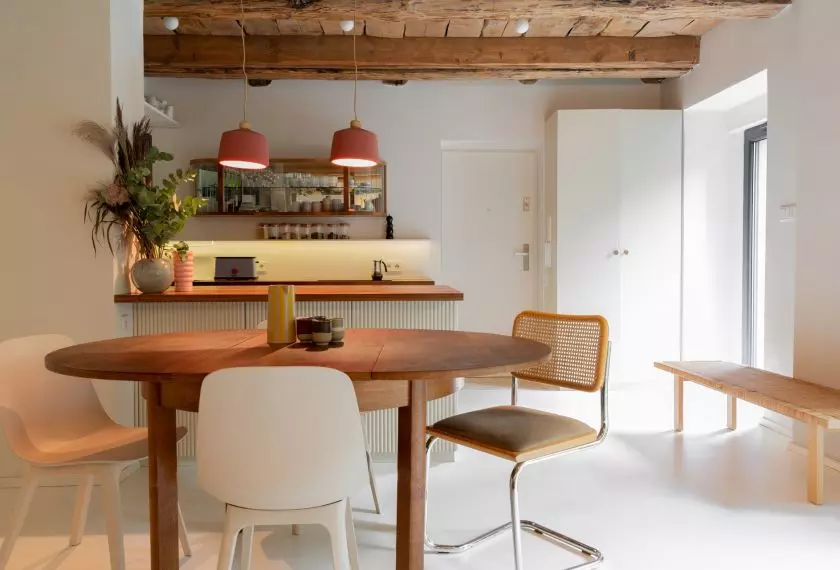
Two common and easy-to-correct mistakes. The first stems solely from a habit rooted in chandelier design— illuminating every interior with a centrally placed light fixture. The second is pendant lights hanging over tables that either blind diners or fail to illuminate the table. This “dazzling” effect—unfortunately not an epiphany, but “glare” in the technical sense of lighting—is a very uncomfortable phenomenon; everyone is familiar with it. People also rarely think about illuminating vertical surfaces—walls—and yet this is a comfortable solution; it creates a sense of space and, while offering greater comfort, is more energy-efficient. We need fewer lux than when “illuminating the air” from the center or with downward-facing lamps. Let’s think in terms of surfaces, allow shadows to exist, and vary the intensity and angles; there are more minor mistakes to be made. Product selection is a separate issue—but that likely applies to many industries. In our industry, there are plenty of very poor-quality products. They come from strange online stores whose dubious origins can be identified with a little effort by checking their terms and conditions, contact information, or return policy. They often use photos of genuine products. What we end up with are products that are far too expensive for what they are—I recommend exercising great caution. As cliché as it may sound—a good plan is far more important than an unlimited budget.
8. You write about light as part of a “healthy diet.” How does well-designed lighting affect our well-being?
Light primarily affects us biologically—directly influencing our hormonal balance, with different wavelengths having different effects. As I mentioned—we know a little; we also know that there’s a lot we don’t know. Indirectly , the wrong kind of light can be a stressor that we may not recognize for a long time. It affects us through the aesthetics of lighting, the atmosphere it creates indoors, and ultimately impacts the environment in which we live—here I’m primarily referring to the problem of light pollution. Again—it affects us directly and the entire ecosystem of which we are a part. Interestingly, in this field, we Poles have world-renowned researchers with a knack for popularizing science, led by Karolina Zielińska-Dąbkowska, Ph.D., an engineer and architect from Gdańsk University of Technology, but public awareness is still quite low, not to mention legislation. However, “an avalanche changes course depending on the rocks it rolls over.” We’re heading in the right direction. It seems there are more than enough reasons to take the issue of lighting very seriously.